



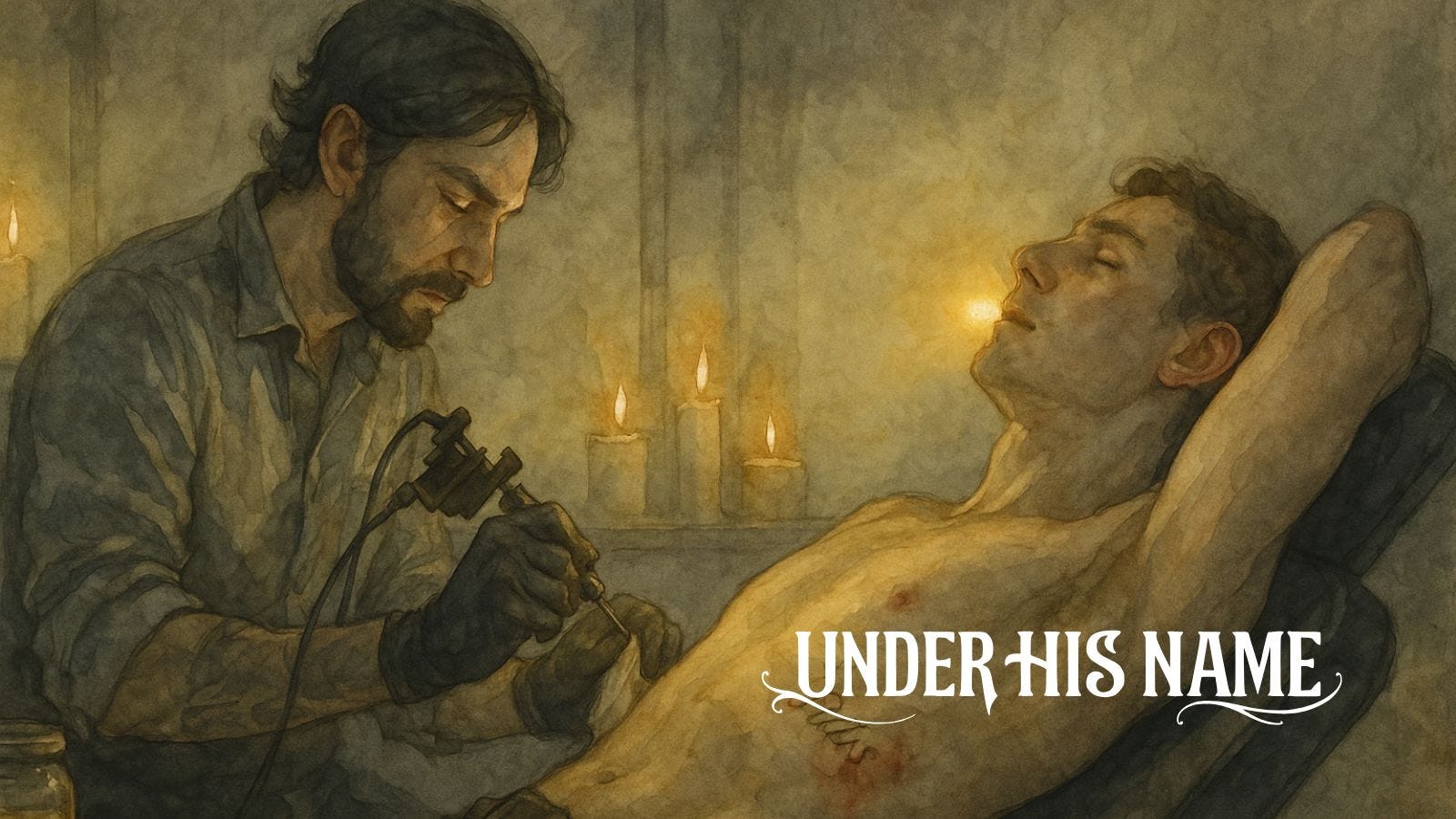
The door bears no hours. Only the faint outline of letters, half-erased by weather and time. Inside, the air hums with current, the whisper of machines, the breath of candles, the weight of devotion. Every week, one man sits in the chair and lets memory pierce the skin. Every stroke of the needle is prayer, every drop of blood an offering.
He is not trying to forget.
He is trying to bring something back.
Under His Name is a gothic love story told through fifty-two sessions of ink and resurrection. It begins with grief and ends with transfiguration, charting the slow, luminous descent from body to myth. The marks change. The room changes. The world itself begins to listen.
And by the final hum, what remains is not a man mourning the dead, but a body that has learned to speak the language of eternity.
Ash & Honey
A drop of honey in the ink, a mouth still stained with ash. As the needle bites along the ribs, grief remembers its own flavour, and the dead breathe sweetness back into the room.
The week began with the scent of sweetness and decay.
It was already in the air when I woke, a faint stickiness at the back of the throat. Outside, the world looked washed out, sky the colour of old bandages, but in the kitchen the light was too bright. It fell across the table where the funeral card still sat, tucked half under a mug I had not yet washed. His name stared up from the crease of paper, black ink on white, flat and unconvincing.
I tried to eat. Toast. Tea. Something ordinary that might persuade the day to behave. The bread browned too quickly. The honey jar resisted, then opened with a soft pop, giving up its sugar in one slow, amber string. It curled across the toast, pooling in the uneven places. When I raised it to my mouth, the smell hit me: flowers long gone, sun preserved, sweetness clinging to a world that had not asked for it.
I took a bite and could not swallow. The honey sat on my tongue, heavy and wrong, tugging at a memory I had been avoiding.
The morning after the funeral.
I had woken with my back stiff and my throat sore. The flat was full of flowers that smelt too alive. The urn had sat on the table like a mistake, too small to contain the idea of him. I had kissed it before they closed it, a stupid impulse, some last childish attempt to turn ritual into contact. When I woke, ash still clung in the corner of my mouth. I could feel the grit against my tongue, taste iron and smoke and something like bone.
I had tried to rinse it away, glass after glass of water, until the sink was grey with what would not dissolve. Only when I bit into toast drowned in honey did the taste shift. Sweetness over smoke. Thick sugar over the hint of char. The contrast had made me nauseous. I had finished the slice anyway, as if completing the act might complete something else.
That same sweetness rode with me down the street to the studio. It clung to my clothes, to the inside of my teeth. By the time I reached his doorway, the familiar undertone of salt had joined it, turning it strange.
He was standing at the counter when I went in, back to the door, shoulders hunched as he worked over a small metal cup. The candles were already lit. Their flames moved in slow agreement when the bell above the frame chimed.
“You’re on time,” he said without turning.
“I didn’t sleep much,” I answered.
He looked round then. There were faint dark smudges beneath his eyes, as if the candles had left soot there. On the tray beside him lay the machine, coils silent, needles ready. On the other side of the tray stood a small glass jar of honey, its label half peeled.
“What is that?” I asked.
“Old habit.” He picked up the jar and tilted it so the light caught the viscous gold. “Keeps the black from drying too fast. The ink flows better. My teacher swore by it.”
He let a single drop fall into the cup. The honey sank and disappeared, swallowed by the deeper darkness. When he stirred, the surface gleamed under the light like liquid night.
“Come,” he said. “The ribs today.”
I hesitated for a second. The ribs meant exposure in a different way. Less visible to the world, more vulnerable to any hand that got close enough. I unbuttoned my shirt anyway. The air against my skin felt cooler than it should. I lay back on the chair and stretched one arm up behind my head to open the side of my body.
His gaze moved over the marks that had already begun to heal. The name at my chest, soft pink at the edges now. The bandage removed from my shoulder, the letters there flattening into permanence. His fingers hovered for a second above each, not touching, tracing the map they made.
“Same name,” he said.
“Always.”
He cleaned the skin along my ribs, the cloth damp and cold. That strip of flesh had always been tender. As a child, I had flinched when anyone touched there. Now I gave it willingly. It seemed right that he should live where it hurt to breathe.
The machine woke, its hum folding itself into the steady burn of the nearest candle. He set the needle to the first point and pressed. The pain was sharp, bright, and immediate. The ribs do not have much patience for intrusion. They arch in instinctive defence, trying to keep organs safe from harm. For a moment my body tried to pull away. He rested his free hand on my shoulder.
“Stay with me,” he said.
“I’m trying.”
The needle moved. Line by line, it traced the letters across the curve of bone. The pain deepened until I could feel it under the ribs themselves, close to the soft things they cage. It was not the clean surface hurt of the chest, nor the stubborn dull ache of the shoulder. It was more intimate than both. Each stroke seemed to enter where breath lived.
Halfway through, when the pain and the hum had woven into something I could just about stand, the smell changed again. The sweetness in the room thickened. It was not only the honey now. It was the burnt sugar of overbaked bread, the cloying perfume of wilting funeral flowers, the faint, bitter trace of smoke that clung to anything that had once been fire.
He saw my face tighten. “Too much?”
“No,” I said. “Just familiar.”
I told him then about the morning after the funeral. The urn. The ash. The kiss. The taste that had refused to leave. The honeyed toast I had forced down in some attempt to anchor myself to the living world.
He did not speak. His brow tensed with careful silence, a small furrow between his eyes. The hand that held the machine did not falter, but something in his shoulders shifted, as if he were bracing against a story he did not know how to stand inside.
As I talked, the air seemed to grow heavier. The candle flames shortened, burning lower, as if consumed faster by a hunger they did not understand. I could swear the room thickened with scent. Ash. Wax. Honey. Salt. All of it braided together until it felt like breathing through someone else’s mouth.
Something warm touched my cheek.
It was light, almost nothing, the faintest brush of sensation. Not a hand. Not quite. More like breath that had learned how to rest against skin. It lingered there, a smear of warmth near the corner of my mouth, exactly where the ash had once gathered.
The hum of the machine faded at the edges of my hearing. For a moment there was only that warmth and the memory it stirred: his fingers on my face when he lifted my chin to kiss me, thumb brushing away the crumbs of whatever we had been eating, that small, absent-minded tenderness I had always mistaken for permanence.
I opened my eyes. The artist was still beside me, head bowed over his work. He had not moved closer. No one stood on my other side. Yet the warmth remained, steady and sure, as if something unseen had leaned in to listen more closely.
When he finished, he pressed a folded cloth to the wound and held it there longer than necessary. The pressure anchored me back into the present, into the chair and the humming light.
“What was his name again?” he asked.
We both knew he did not need to ask. He had heard it spoken, inked it into my body three times already. Still, he waited, eyes lifted to mine.
I said it softly. The sound hung for a moment above us. Every candle in the room flickered as if the word required air of its own.
He nodded once, as if to a fact rather than a ghost. He taped the bandage into place. His fingers were warm where they brushed my side.
When I left, the street outside felt ordinary. Cars. People. A dog pulling on a lead. Yet the taste of honey lingered on my tongue, stubborn and slow to fade, mingling with the faint salt of blood that had seeped into the corner of my mouth.
Sweetness and ash, sharing the same space.

So moving 😢