



The door bears no hours. Only the faint outline of letters, half-erased by weather and time. Inside, the air hums with current, the whisper of machines, the breath of candles, the weight of devotion. Every week, one man sits in the chair and lets memory pierce the skin. Every stroke of the needle is prayer, every drop of blood an offering.
He is not trying to forget.
He is trying to bring something back.
Under His Name is a gothic love story told through fifty-two sessions of ink and resurrection. It begins with grief and ends with transfiguration, charting the slow, luminous descent from body to myth. The marks change. The room changes. The world itself begins to listen.
And by the final hum, what remains is not a man mourning the dead, but a body that has learned to speak the language of eternity.
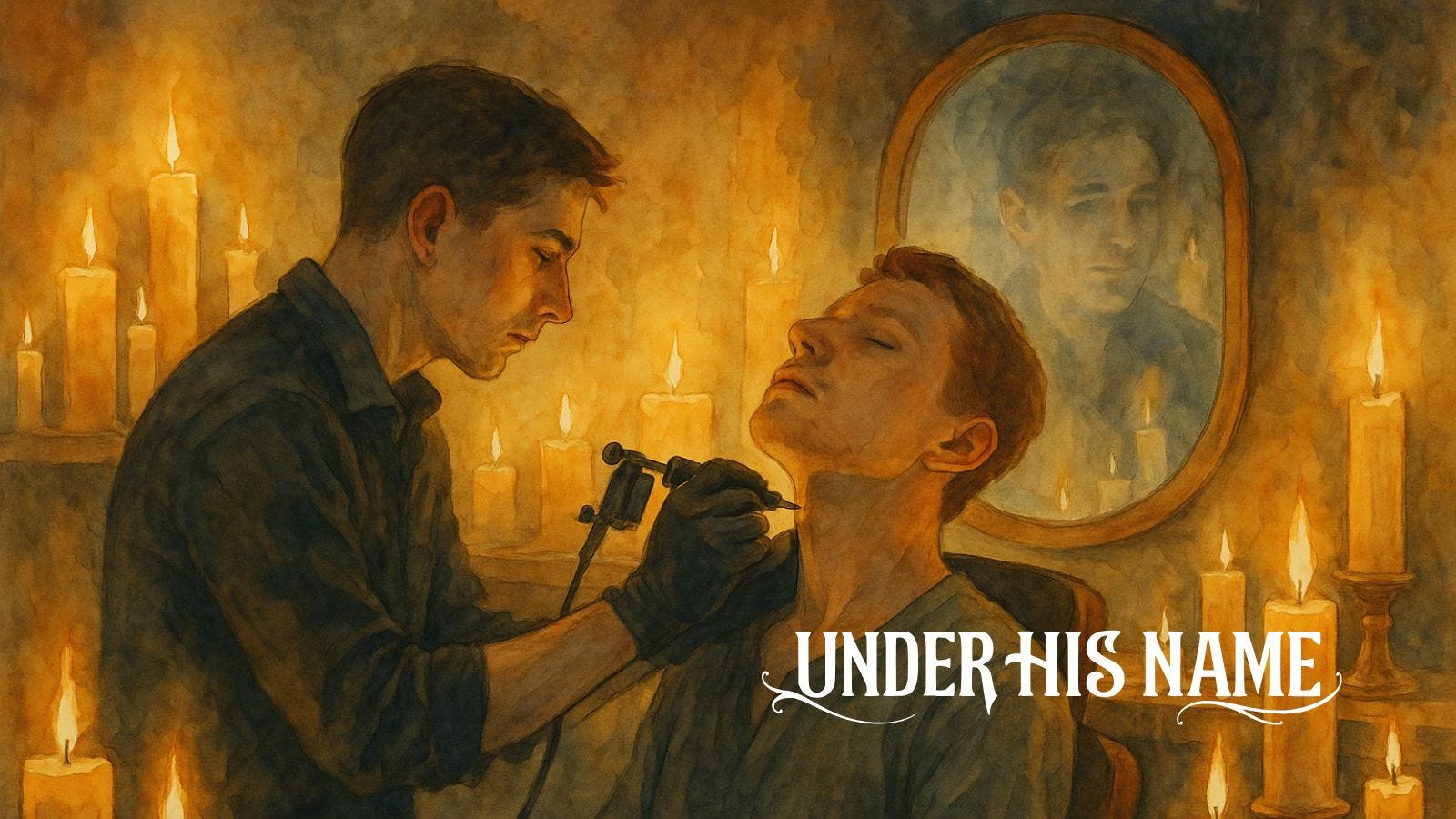
The Candle Room
The studio turns chapel. Candles crowd the walls, a throat becomes an altar, and the voice that once spoke his name learns how it feels to have that name carved beneath it.
By the third week, the studio smelled of wax.
It met me on the stairwell even before I reached his door, a warm, heavy sweetness that settled in the back of the throat. The first time I had come here the air had smelled only of antiseptic and metal, the clean bite of new needles and scrubbed surfaces. Now the scent had changed. Something soft had been added, something that did not belong to clinics.
He had begun lighting candles before each session. At first it was a single dark red stub on the metal tray, then three along the windowsill. This time, as I pushed the door open, the room was already lined with them. Fat pillars, narrow tapers, small glass cups holding flickering points of fire. Their flames moved when I stepped inside, as if stirred by my arrival, and the shadows they cast climbed the walls like smoke learning to walk.
He glanced up from the counter where he was laying out gloves and needles. The candlelight caught on the small silver ring in his ear, on the ink along his wrists that disappeared beneath the rolled shirt cuffs.
“You’re early,” he said.
“So are you,” I replied.
He smiled briefly and nodded towards the candles. “They help my hand settle,” he said. “I work better when the light is soft.”
Maybe that was true. To me, though, the flames looked less like habit and more like ritual. There was nothing casual in the way he had placed them. Pairs on either side of the chair. One alone near the mirror. A row of four along the window like a small congregation facing in.
I shrugged off my coat. “Where today?”
He studied me for a moment. His gaze moved over my chest, where the first name lay healing, then to the fresh bandage on my shoulder. Two marks so far, two repetitions of the same word. A faint crease appeared between his brows, as if he were reading a map that was only just beginning to reveal what it wanted to be.
“The throat,” he said at last. “Here.” His fingers brushed the hollow at the base of my neck, just above the place where my pulse beat against skin.
My mouth went dry. “Bold choice.”
He lifted a shoulder. “You said you wanted him close.”
The name would lie just beneath the pulse, where words begin, where breath turns into sound. It felt right. It felt terrible. I sat.
The chair creaked softly beneath my weight. The machine rested on the small steel trolley beside us, silent for now, a coiled possibility. He cleaned the skin at my throat with slow, careful strokes. The liquid was cold, shocking after the warmth of the room. Gooseflesh rose along my arms. I tried to hold still.
“Head back a little,” he murmured. His hand slid beneath my jaw, guiding it. His palm was cool through the glove. The position exposed everything: the curve of the neck, the line of the collarbone, the faint flutter of the artery that refused to be calm.
When the machine started, the sound seemed to come from the candles first. The hum rose slowly, settling into a low note that joined the small whisper of burning wicks and the distant city noise beyond the glass. It was almost gentle, like a heart murmuring secrets to itself.
The first sting came without warning. A bright, exact intrusion just beneath the skin. My whole body flinched. The pain shot out along my shoulders and down my spine. For a moment the room dimmed. Then the world shifted.
I saw him again.
Not as he had been by the river, damp and grey. Not as a shadow by the sink. This time he was younger, the way he had looked when we still believed we could hide our love inside the cracks of holy places.
We were kneeling behind the last pew. The church was crowded, light pouring in through stained glass, gold and blue and red falling across the stone. Incense hung like a low cloud. The priest’s voice rolled above us in a language that promised salvation to everyone except those who loved as we did.
We had slipped into that back pew late, pretending to be just another pair of men too tired to sit near the front. His shoulder pressed against mine. The hymn rose, full and obedient. He leaned close until his lips were almost at my ear.
“If we are going to burn,” he whispered, “we might as well enjoy the warmth.”
I had laughed, quietly, the sound swallowed by the organ. Candlelight flickered across his face, picking out the curve of his mouth, the small scar at his chin, the lovely wreck of him. During the second verse, his hand slid along the underside of the pew, searching for mine. Our fingers met in the shadows and laced together. Each time the congregation sang the word amen, he squeezed.
Between hymns, beneath the cover of people rising and sitting, he kissed me. Quick, breathless brushes of lips that tasted of candle smoke and skin. We dared holiness to notice and do something about it. Nothing did. Only the flames trembled a little harder.
“Breathe,” a voice said.
I came back to the chair. The studio snapped into focus. The candles were closer than stained glass, smaller than church pillars, yet the light they cast felt just as stern.
The tattooist paused, the needle held a fraction from my skin. “You are shaking.”
“I know,” I said. My voice sounded raw, scraped thin by memory.
His hand moved to my chin again, firm and steady. “It will be easier if you let the breath move.”
I inhaled. The smell of wax and antiseptic and faint salt filled me. I exhaled, slow. He began again.
The hum deepened, lower, almost soothing. The pain gathered, then spread. It travelled up into my jaw, down into my chest, across the collarbones. There is a point where hurt folds in on itself and becomes something else. Not comfort, but a clarity that feels almost like pleasure. Each needle stroke seemed to thread the present moment through the body of the past, stitching everything together beneath the skin.
He worked with care, drawing the curves of each letter, wiping away blood before it could fall. Sometimes his knuckles brushed my lips. Sometimes his wrist rested against my chin for balance, his pulse a faint flutter against my jaw.
At last the machine quietened. The sudden absence of sound rang in my ears. He leaned close, his face not far from mine, breath warm with coffee and the hours he had already worked that day. His gaze flicked over the fresh ink, assessing.
Then, very softly, he spoke the name.
He was testing the pronunciation, nothing more, yet the effect was immediate. The sound of it moved through me like breath after drowning, that first desperate draw of air when the body decides it will live after all. My throat tightened. The name had been said in many places: in bed, in anger, in disbelief, in grief. Hearing it here, over his own work, felt like its most honest use.
He stepped back and gestured to the mirror.
In the glass, lit by the low, restless candles, I saw myself. The new mark sat just beneath the pulse, red and glistening, the letters still swelling. For a heartbeat, there were two of me. The candlelight broke across the surface of the glass and formed another face behind my own. Familiar eyes, familiar mouth. He was smiling, the slow, private smile he used to wear when he thought no one else could see.
I blinked. The second face dissolved into light.
Behind me, I heard the shift of cloth. The artist had turned to blow out the candles. Some part of me panicked at the thought of that sudden dark, of this small chapel reverting to a simple room again. I reached out and caught his wrist.
“Leave them,” I said.
He looked at me for a long moment. His skin was warm beneath the glove. Then he nodded and set the snuffer aside.
We stood together, watching the wax run down. It curved and cooled in slow rivers, pooling on the counter and along the windowsill, building small pale ridges where each flame ate itself shorter. The room grew quieter, softer. The marks on my body pulsed in time with the light.
Eventually he spoke. “They will burn out on their own.”
“So did he,” I thought.
The words stayed inside. The candles burned on, their teardrops of wax surrendering to gravity, falling where they had to fall.

This series is wonderful Rowan x
Loving this Mr T x