




In the domed city of Arrow-Far, where air is rationed and water is an inheritance, the Dry Room decides what the planet remembers. Behind sealed glass and polite smiles, Salt Mother Helka Vyne and her clerks trade steam, silence, and obedience. The minutes flow, the markets breathe, and every kindness has a price.

Welcome to Arrow-Far, the first story in The Minute Economy.
A planet where air is currency, time is rationed, and kindness is a regulated act. In the Dry Room, policies are written to look like mercy. Beyond the glass, the wards learn what scarcity sounds like when it hums through the pipes. One chapter at a time, the world unfolds, measured, monitored, and always a little too dry.

The Dry Room
Prologue
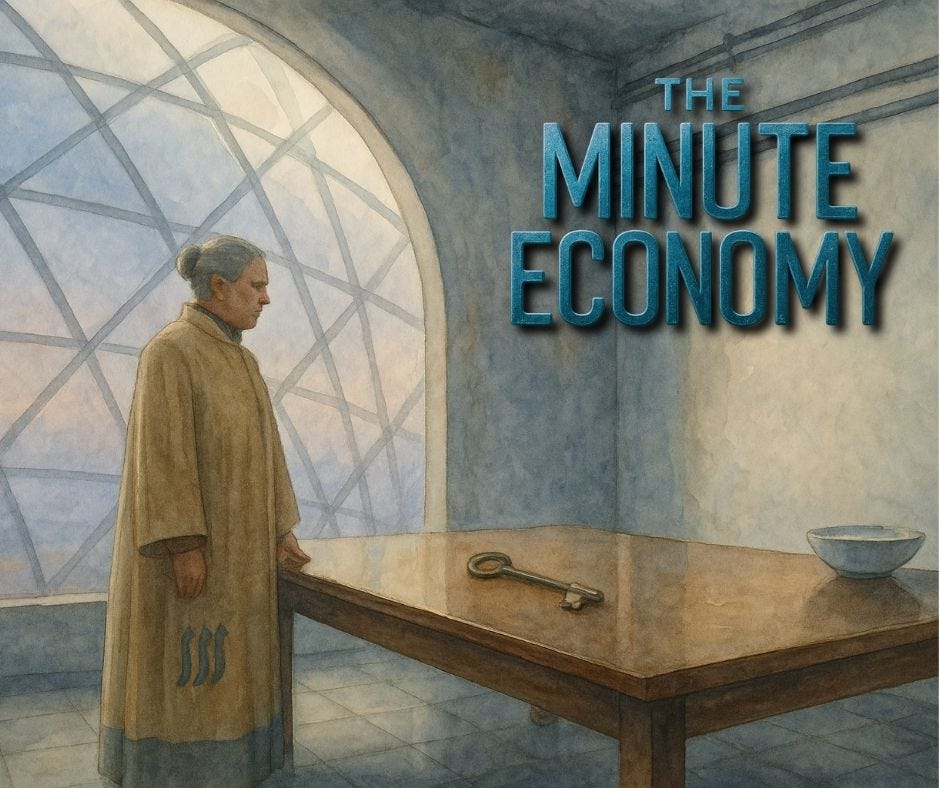
They called it the Dry Room as a joke that stopped being funny. The air took the shine off your lips. Bowls of silica gel sat in the corners like tame pets. The windows looked onto Founders’ Row where the paving was always clean, and the plants always looked suspiciously comfortable with scarcity.
Salt Mother Helka Vyne set her keys on the table. The keys were ceremonial, big enough to be seen by a camera, small enough to pass through a pocket without a clink. Her robe had a water mark stitched into the hem, three neat chevrons that said permission. The room smelled of polish with a lemon edge. Most rooms on Arrow-Far did. Pride came bottled.
“Agenda,” she said.
Clerk Ry Nox, a thin man whose tie looked like a private struggle, slid a slate across the table. “Minute Exchange, trial. Petition management. Valve etiquette at entertainment venues.”
“Say bar,” Helka said. “If we keep calling the Pink Valve a venue I will cough myself to death.”
Nox coughed. He did not die. “Yes, Salt Mother.”
The third person in the room, a legal mind with eyelashes sharp enough to pierce a regulation, kept her eyes on her notes. Isola Therin, Counsel to the Trust. On Arrow-Far everyone who mattered had three names and at least one lie.
Helka turned the slate so it faced her. “Explain this Exchange again and use words a grandmother would forgive.”
Nox brightened. Pride lived in small briefings. “We securitise unused steam minutes in Founders’ Row, then lease them back to Row at a discount. The poor wards can purchase bundles with a delay fee. Markets create honesty.”
“Markets create noise,” Helka said. “Noise moves faster than policy. Can we make it look like a safety measure.”
“Absolutely,” Nox said, too quickly. “We call it Condense Control. We say too many private hoods stress the condensers. We recommend that citizens store their comfort with us for community smoothing.”
Isola looked up. “We will need a failure to point at.”
“Plenty of those,” Helka said. “A hood here, a drip there. The planet makes mistakes for free. We only need to time them.”
The door breathed and let in a man who looked as if his uniform had been ironed over a chair with nobody inside it. Port Warden Kel Hadrin. He did not sit. Some men do not sit around women who pay them.
“You asked for valve incidents,” he said. “Two tonight. One in the keel club, one by the ribs market. Both resolved. No injuries.”
“The club is called the Pink Valve,” Helka said. “And the other site is called the Dock Market. You read like a warning label.”
Hadrin blinked. “Yes, Salt Mother.”
“Do I need to be there tonight,” she asked.
“No,” he said. “Band is scheduled. The hostess pays her licences. She keeps her exits clear.”
“Good,” Helka said. “If the club behaves, we can afford to be moral. If it misbehaves, we can afford to be poor.”
Isola finished a line and blew on the ink. “On petitions. We have a draft to lengthen shower slots on Row. The Founders will sign if we say the word legacy and print it on paper thicker than shame. If we then open the same petition to the wards we will learn who likes to collect signatures. Useful for our files.”
Helka’s mouth made a small shape that might have been a smile. “The Petition Mirror. We sell kindness to the rich and buy lists of the brave from the poor.”
Nox made a noise meant to sound like respect and landed nearer to thirst. “There is also the matter of the ribbons.”
“The ban,” Hadrin said. “Uniform discipline. No unauthorised colours.”
“Colours are not the problem,” Helka said. “Meaning is the problem. Men get violent when a piece of thread does their job better. We will not ban a ribbon. We will create a queue that does not recognise it.”
Nox fumbled his stylus. “How.”
“Inspection days move,” Helka said. “They always move until a pattern finds them. Once a pattern is named it becomes a parade. We will change inspection hours in the wards. We will call it oxygen safety. Anyone who wears a blue ribbon will be asked to show their valve permits. They will be kept waiting because safety takes time. They will still be allowed to pass. A ban is loud. Waiting is policy.”
Isola’s lashes did a small, lethal dance. “Defensible. Ugly. Likely to work.”
Helka looked back to the window. Founders’ Row shone under lights that pretended to be dusk. Above the dome the first dust of Glass Sleet would be gathering, little pebbles of ice that the planet threw up in playful fits. When the sleet came the old skins of the lander complained, and people remembered that air was not a gift. Fear made good policy if you fed it small portions and kept it on a schedule.
“Recruitment,” she said. “We will need an ear in the algae beds and a nose in Coil.”
Hadrin cleared his throat. “There is a boy in Algae with a permit problem. Sine Ryd. Shoulders like a poster. He wants to be seen. Men who want to be seen are easiest to hire. We can fix his paperwork in a way that leaves a small, tasteful hook.”
“Good,” Helka said. “What about Coil.”
“Steward says there is a woman in Coil who prunes basil at night,” Hadrin said, as if basil were a controlled substance. “Name of Verity Dunn.”
Nox glanced up. “She filed a variance argument in neat handwriting. The type who will bring twenty people to a petition if she believes paper can weigh more than a valve.”
Helka let the name sit on her tongue. Names have shapes. Verity tasted like clean stubbornness and late work. “We do not touch her yet,” she said. “Busy people make mistakes faster if you let them believe they are invisible.”
“You want to watch,” Isola said.
“I want to measure,” Helka said. “If she turns her minutes into signatures, good. If she turns them into laughter at a club, better. Laughter makes news slow, but it makes enemies easy to photograph.”
Nox scribbled. “What about the steward.”
“Which steward,” Helka said. She kept her voice airless.
“The one at the Red Seal,” Nox said. “The one who looks as if he irons over a chair and then puts the chair on.”
Hadrin made a sound with no shape. “Shade. Good with people. Good with policy. Keeps his badge straight. Too straight, perhaps.”
“Invite him to the Valve on a night with decent music,” Helka said. “Tell him to count exits and pretend to be bored. If he is clever he will find a reason to be kind once. If he is not, I will find a reason to move him.”
Isola capped her pen. “To summarise. We move on the Exchange and call it safety. We mirror a petition. We slow ribbons with waiting. We hook the boy in Algae. We watch the woman in Coil. We send the steward to a club and ask fate for a story.”
“Summaries are happy,” Helka said. “Let me hear a worry.”
Nox swallowed. “If the Founders hear about the Exchange, they will want more discount. If the wards hear, they will call it theft.”
“Then we keep the Founders busy with a grieving wall,” Helka said. “Carve names into stone that does not leak. Give them something to touch. As for the wards, we tell the truth. The planet is a joke that does not love us. We ration the punchline.”
Hadrin shifted. “One more noise. The Pink Valve crowd. They share steam minutes under the table. Four here, five there. It buys goodwill. It loses us data.”
“Let them,” Helka said. “Some kindness pays the ledger twice. If they grow proud, we inspect their drains. Nothing makes a club humble like a blocked trap.”
The room’s dehumidifier clicked. The bowls of silica gel eased themselves two shades whiter. Outside, a breeze moved along the Row that no other ward could afford. The planet gave everyone wind. Only the rich taught it to behave.
“All right,” Helka said. She stood, and the robe made the sound silk makes when it remembers a lake. “The Exchange launches at Turnout. The Mirror goes up a week later. Announce nothing. Banners are for people who need to see themselves on a banner.”
Hadrin saluted a man who preferred to salute furniture. Nox gathered his papers as if they might try to flee. Isola paused by the door.
“You do not enjoy being the villain,” Isola said.
Helka adjusted the keys in her pocket. “Enjoy is not a word for this job. Villain is a story other people write when they do not like the price of water.”
“The price is high,” Isola said.
“The price is honest,” Helka said. “Honesty looks cruel when you print it on a bill.”
The Dry Room opened its mouth and swallowed them one by one. When Helka stepped into the corridor, the Founders’ plants turned their leaves to the air like obedient children. Far below, in the Dock, a girl practised a dance that would one day make a steward take his badge off. Far above, the Glass Sleet chose its first stone and wondered whose roof to greet.
The planet kept its sense of humour. Helka kept her ledger.
