



The door bears no hours. Only the faint outline of letters, half-erased by weather and time. Inside, the air hums with current, the whisper of machines, the breath of candles, the weight of devotion. Every week, one man sits in the chair and lets memory pierce the skin. Every stroke of the needle is prayer, every drop of blood an offering.
He is not trying to forget.
He is trying to bring something back.
Under His Name is a gothic love story told through fifty-two sessions of ink and resurrection. It begins with grief and ends with transfiguration, charting the slow, luminous descent from body to myth. The marks change. The room changes. The world itself begins to listen.
And by the final hum, what remains is not a man mourning the dead, but a body that has learned to speak the language of eternity.
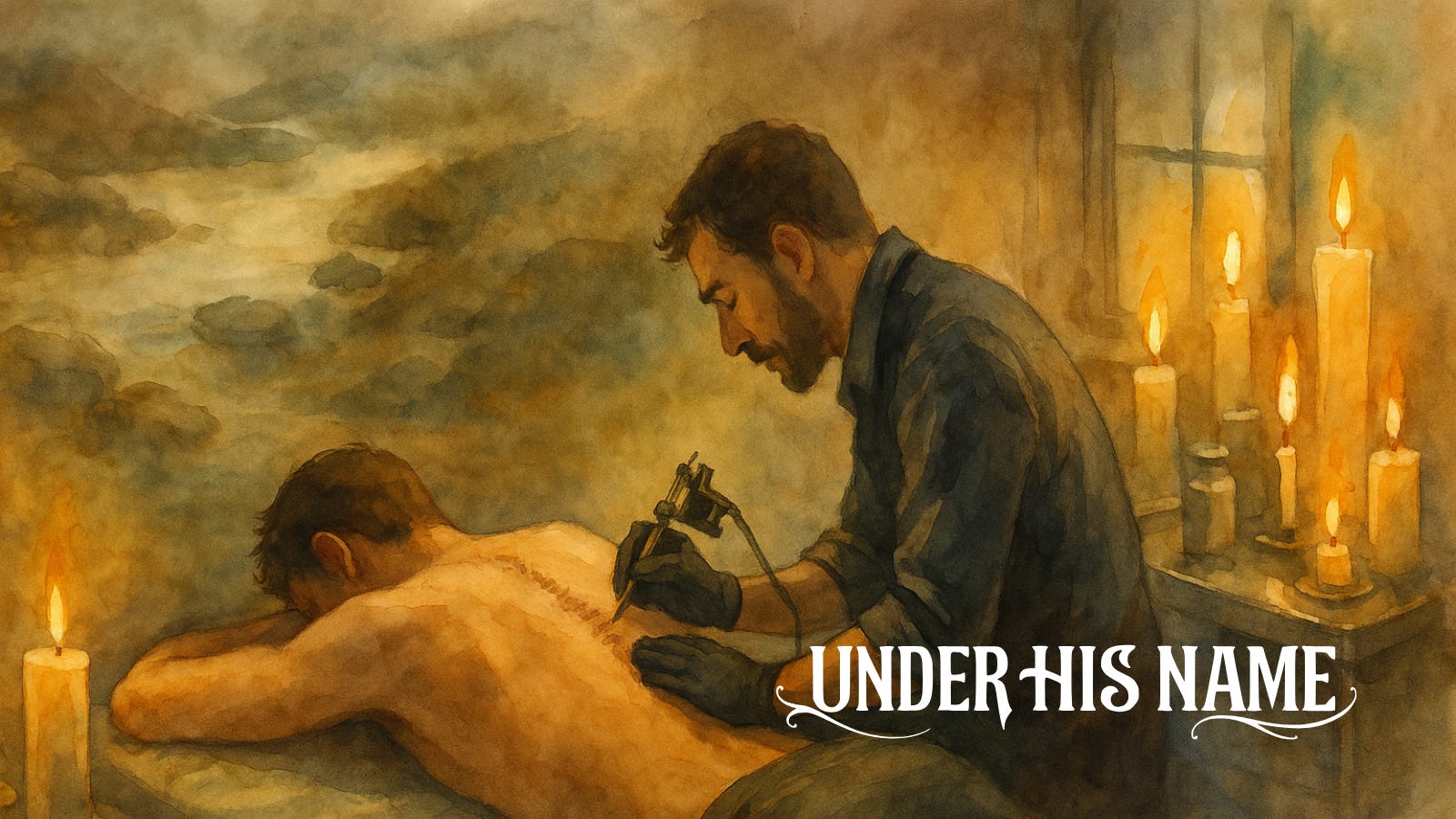
The River Stone
Marked along the spine, the body becomes a riverbank. As the needle carves its way down, stone and flesh trade memory, and the dead appears again, standing in the water with something the living cannot quite name.
He chose my spine.
“A straight column,” he said, looking at me with a kind of clinical tenderness. “Steady. Deliberate.”
The table beneath me was cold enough to make my skin tighten. I lay face down, shirt off, arms folded under my head. The room seemed longer from this angle, the candlelight stretched across the ceiling, their small flames reflected in the steel of the trolley. I could hear the faint rattle of needles, the wet stir of ink in the cup.
“Tell me if you need to stop,” he said.
“You know I won’t,” I answered into the crook of my arm.
He did not reply. The machine woke instead, that familiar hum rising from somewhere low in the air. It vibrated through the table and into my ribs even before he touched me. I felt him draw a line with his gloved finger down the centre of my back, tracing the route the needle would take, from just below the nape of my neck to the small of my back.
“Same name,” he said.
“Always.”
Then the first stroke came.
The skin along the spine is thin. It has no patience for lies. When the needle bit there, the pain shot clean and bright all the way through me, as if it had hit not only flesh but bone. Each movement of his hand seemed to carve into the vertebrae themselves. The hum deepened, marrying itself to the rhythm of my breath.
I tried to think of something else. My mind went, almost at once, to the river behind his house.
It wasn’t beautiful in the way people like to imagine rivers. Not clear or blue or scenic. It was slow and brown, thick with silt, its surface broken by the occasional hunk of rock that looked like a shoulder shrugging up from the depths. In summer, dragonflies hovered above it. In winter, mist clung low, turning it into a moving bruise that cut the town in half.
We used to throw stones at its surface and count how many skips each one managed before it surrendered and sank. His best was seven. Mine was never more than three. He’d tease me every time.
“You’re throwing like you want it to drown,” he’d say. “You’ve got to give it a chance.”
“You just pick flatter stones,” I’d argue.
He’d grin and hold one up between finger and thumb. “You’ve got to know what wants to fly first.”
The memory softened the edges of the pain for a moment. Then he hit a new point along the spine and the hurt surged again, a hot line that ran down into my lower back. My fingers curled against my arms.
“Breathe,” the artist murmured. “You’re holding everything too tight.”
I realised I’d been clenching every muscle. My jaw. My shoulders. Even my toes pressed hard against the footrest. I let the air out slowly, then dragged more in. The candles flickered as if they heard. He waited until the rhythm steadied, then continued.
“I keep thinking of his river,” I said, my voice muffled by my own skin.
“Tell me,” he said. He always said that. It gave my mouth something to do while he made new wounds.
“There was a stone we kept for almost a year,” I said. “He found it one day. Flat and grey. Felt like something that had been waiting.”
The needle moved lower. The hum filled my head. “Where’d you keep it?”
“On his windowsill. He said we couldn’t waste it on a day that didn’t deserve it.”
I could see it as I spoke. That small, perfect oval of river rock, sitting between a chipped mug and an empty glass bottle. Whenever I stayed over, I’d find him touching it in passing, thumb rubbing the same patch over and over, as if trying to polish the river’s memory into his skin.
“You ever skip it?” the artist asked.
“Last morning,” I whispered.
The words surprised me. I hadn’t meant to say them out loud.
The last morning. The one I don’t like to linger on. The air damp. The kitchen cold. The way his hands had felt when I reached for him. Not feverish. Not chilled in a way that speaks of illness. Just cool. Smooth. Like something that had been in water too long.
We’d gone down to the river because he said he wanted to see how high it’d risen after the rain. His breath had made small ghosts in the air. I remember watching the mist curl out of his mouth and thinking he looked like a saint in some badly painted icon, smoke instead of a halo.
He’d taken the stone from the windowsill and held it the whole walk there. At the bank, he’d kissed me once, quickly, then pulled back with that same odd look I still don’t know how to name. Resolve. Resignation. A kind of tired peace.
“Seven,” he said. “I’m going to get seven again.”
He got five.
Now, under the needle, I felt the same resistance he’d held in his body that day, the way his muscles seemed to push back against my touch without meaning to. Flesh turning to stone. Stone remembering the shape of touch. The line of ink the artist carved down my back started to feel less like writing and more like excavating. As if he were uncovering something that had always been there.
“You’re quiet,” the artist said.
“I’m at the river,” I answered. “He’s standing in the water.”
The machine kept its low sermon. The pain settled into something duller, but it had reached that deep place where sensation turns into echo. Every time the needle lifted, I felt it still, vibrating inside the bone.
“I keep reaching for him,” I said. “In the memory.”
“Does he let you?” he asked.
Sometimes he did. Sometimes he stepped back, laughing, letting the water reach his thighs. Sometimes he waded in so far that the fog took him. The river kept changing him each time I replayed it, like it wanted him for itself.
When the machine finally stopped, the silence was abrupt. I felt the sting of open skin and the weird absence of the hum. The candles hissed softly. My back throbbed.
“Stay there a moment,” he said. “You’re pale.”
“I keep seeing him,” I whispered. My face was pressed against my forearm. My voice sounded distant. “He’s standing in the water. He’s holding something.”
The artist’s hands were gentle as he cleaned the line down my spine. Cool fluid. Careful pressure. “What’s he holding?”
“I don’t know,” I said. The room tilted slightly. The last image the river offered sharpened. “I think it’s me.”
He said nothing to that.
He laid the bandage along my back, the tape pulling slightly at the edges of the fresh wound. For a moment his fingers lingered, tracing the ridge of my spine through the gauze, following the hidden letters he’d just made. It felt like he was reading a sentence written just for him.
Then his hand left me. The air rushed into the space where his touch had been. Somewhere far off, the river moved on, carrying its stones and its secrets toward a sea that already smelled like him.
